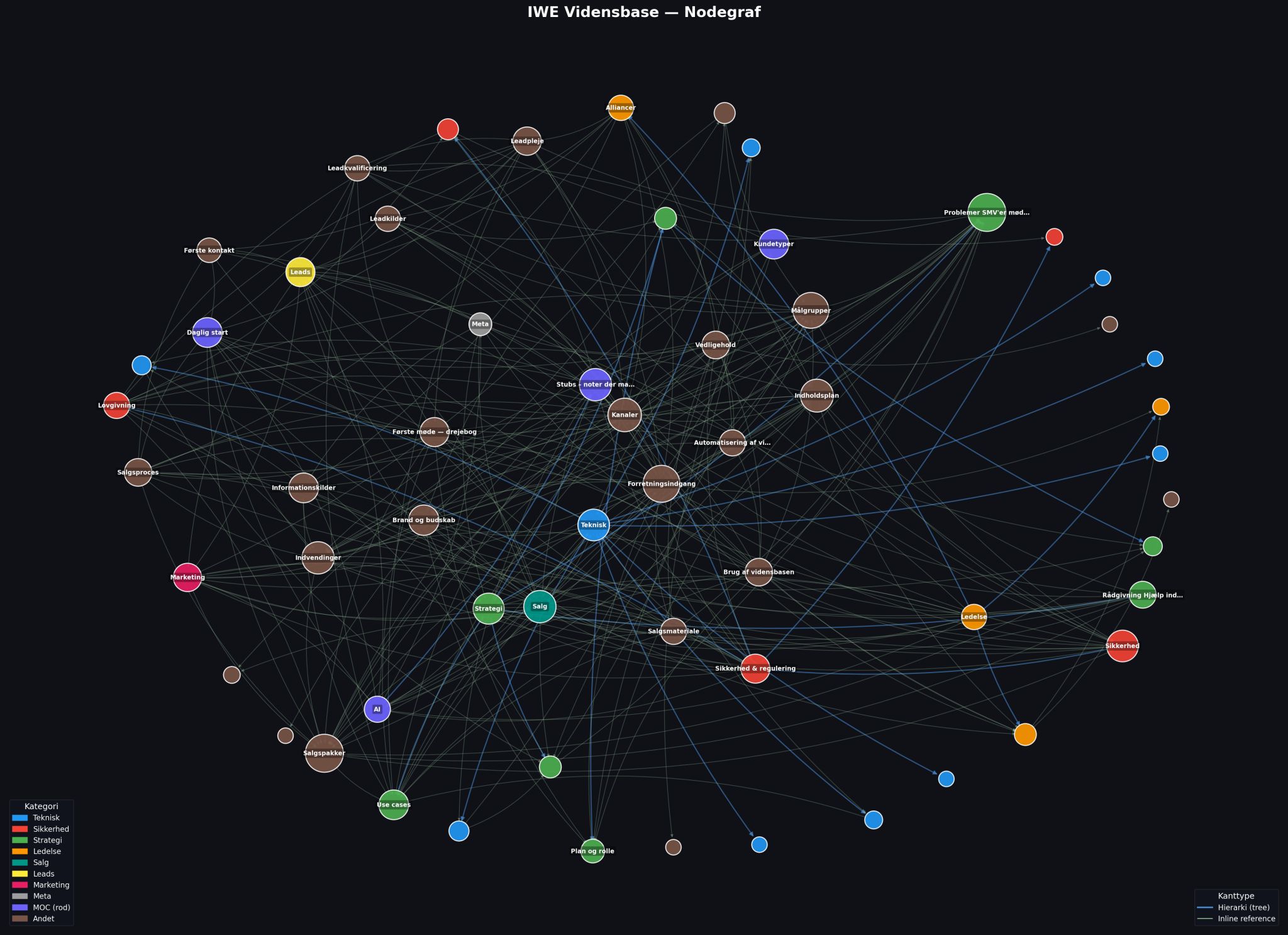
My knowledge base isn't an archive — it's an ASSET!
I use it all the time. And keep it updated all the time. And then I share it with artificial intelligence.
It wasn't always like that.
Before most notes ended up dying quietly deep in a folder structure.
That's not a problem with the notes. It's a structural problem. And that's the problem I've spent the last month solving.
You probably know the situation:
You take notes for a meeting. You save them somewhere with a name that makes sense that day. Two weeks later, you need that insight again, and it's gone — not because it doesn't exist, but because you can't remember what it related to, or what the point really was.
Tags help a little, but they're flat. They can tell you that two notes are about the same thing. They can't tell you what one presupposes for the other to make sense.
And folders are even worse: they force you to choose one location for a note that logically belongs in three places at once.
I've stopped fighting it. Instead, I now use a system that treats knowledge as what it is: a graph, not a file system.
The tool is called IWE.
And the central concept is inclusion links — and it's simpler than it sounds. When you place a markdown link on its own line, IWE registers it as a structural relationship. The parent document becomes the parent of the linked document.
This way, you build hierarchies without folders, and the same note can easily have multiple parents. My note on data security belongs under both the technical foundation and under sales arguments — because it does. In IWE, you can do that without having to save the same content in multiple places.
The graph approach that IWE uses provides context in both directions. Parents add background; children add detail. It sounds abstract, but in practice, it means I can always zoom out to understand why a note is relevant, and zoom in to see exactly what it contains.
Here's where Claude Code comes in.
IWE has a CLI built to be used by AI agents.
This is not a coincidence — it's a deliberate architectural choice that IWE calls The Context Bridge:
The knowledge base as a shared workspace for both me and my AI. When Claude Code is working on a task — writing a blog post, preparing for a client meeting, formulating a sales strategy — it can retrieve precisely the part of my knowledge base that is relevant. Not everything. Not nothing. The right context, at the right depth, with the relationships intact, that make the information usable.
In practice, Claude runs a command like iwe retrieve -k sales_process and gets a structured excerpt: what the sales process is, what objections belong to it, what customer types are relevant, and what has been said about tone and message. It takes seconds. And because the structure is good, the result is good.
I'm not interested in bragging about my workflow. But I do want to put forward the one number that actually changed my perception of the system: previously, I used to spend 30-45 minutes "getting started" — finding notes, refreshing context, deciding what was relevant. Now it takes 5 minutes. Not because AI is magical, but because the structure is good.
A messy knowledge base provides messy context to an AI, and messy context yields poor results. It applies here as everywhere else: garbage in, garbage out.
You don't need either IWE or Claude Code to adopt this mindset. But you can benefit from asking yourself one question: are your notes structured to be used — or to be stored?
If you answer honestly, you probably already know whether you have an archive problem or a work tool.
A knowledge base that is difficult to use is not used. It's not a lack of discipline. It's a lack of design.
And lack of design can be addressed.
Check out IWE — it's even open source: iwe-org/iwe: Markdown memory system for you and your AI agent
We help companies think systematically about knowledge, AI, and business value. If you are curious about what this could concretely mean for your organization — book a no-obligation chat.