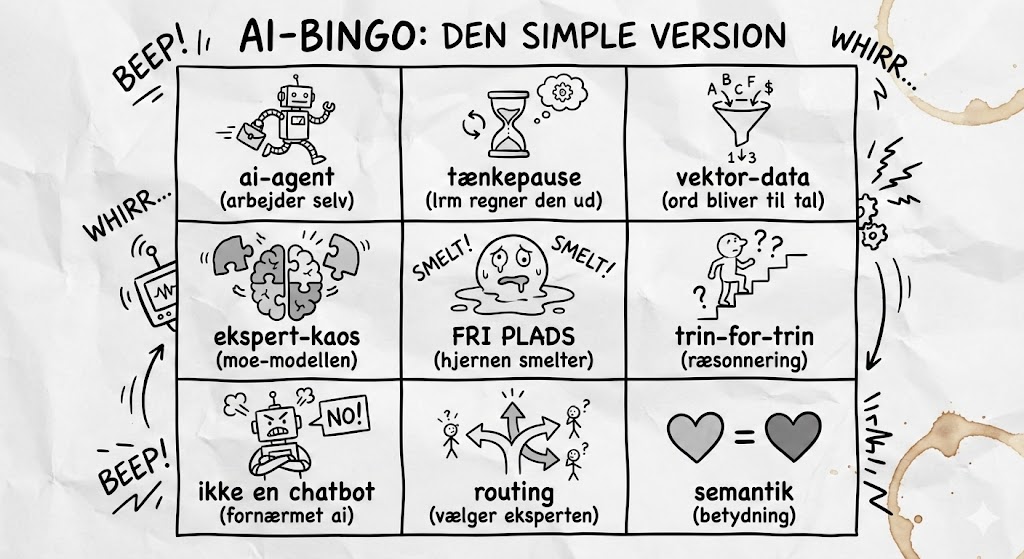
Do you know all the AI lingo? Let's play the AI bingo here:
-
AI Agents: These are AI systems that can reason and act autonomously to achieve goals. Unlike chatbots that respond to individual prompts, AI agents go through a cycle of perceiving their environment, reasoning about the best next steps, acting on their plan, and observing the results. They can perform various roles, from booking travel to analyzing data or managing IT infrastructure.
-
Large Reasoning Models (LRMs): These are specialized Large Language Models (LLMs) that have been fine-tuned for reasoning. They are trained to work through problems step-by-step, unlike standard LLMs that generate immediate responses. LRMs are trained on problems with verifiable answers (like math or code) and use reinforcement learning to generate sequences of reasoning that lead to correct outcomes. The "thinking" pauses you might see from a chatbot are often the result of an LRM working through its reasoning process.
-
Mixture of Experts (MoE): MoE is an architectural approach that divides a large language model into multiple specialized "experts" (neural subnetworks). For any given task, a routing mechanism activates only the specific experts needed. The outputs from these activated experts are then merged to form a single representation. This allows for scaling up model size without a proportional increase in compute cost, as only a fraction of the model's total parameters are used at inference time for any given token.
-
Vector Database: In a vector database, data (like text or images) is not stored as raw files but is converted into numerical representations called "vectors" using an embedding model. These vectors capture the semantic meaning of the data. The benefit of this is that searches can be performed as mathematical operations, looking for vectors that are "close" to each other, which translates to finding semantically similar content.
-
Model Context Protocol (MCP): MCP standardizes how applications provide context to LLMs, enabling them to interact with external data sources, services, and tools. It creates a standardized way for AI to access systems like databases, code repositories, or email servers, eliminating the need for developers to build custom connections for each new tool. An MCP server acts as the interface for the AI to understand how to access these external systems.
So have many did you know? Did you learn anything new?